

The word kamikaze is one of the most emotionally charged and symbolically complex terms to emerge from the twentieth century. Although many associate it solely with the final months of the Pacific War, its origins stretch back more than six centuries, rooted in the legend of the divine winds that protected Japan from Mongol invasion. In the modern era, however, kamikaze evokes a very different set of images: young pilots, farewell letters, wooden barracks, and aircraft that symbolized both desperation and a nation’s final attempt to alter a war’s outcome. Understanding the story behind the kamikaze requires a journey deep into Japan’s wartime psyche, its cultural traditions, and the environment in which young men faced decisions shaped not by personal desire but by the unyielding weight of circumstance.
Japan in 1944 and 1945 was a society under immense strain. After initial success early in the Pacific War, the momentum shifted dramatically. Allied forces advanced steadily across the Pacific islands. Japan’s supply lines stretched beyond their limits. Raw materials dwindled. The skies above major cities grew increasingly vulnerable to air raids, and the empire’s military planners faced the reality that conventional strategies could no longer slow the approaching collapse. Each month tightened the pressure. Every strategic analysis pointed toward a conclusion that few could publicly acknowledge. It was in this climate that military leaders made a decision that would leave a permanent mark on global memory.
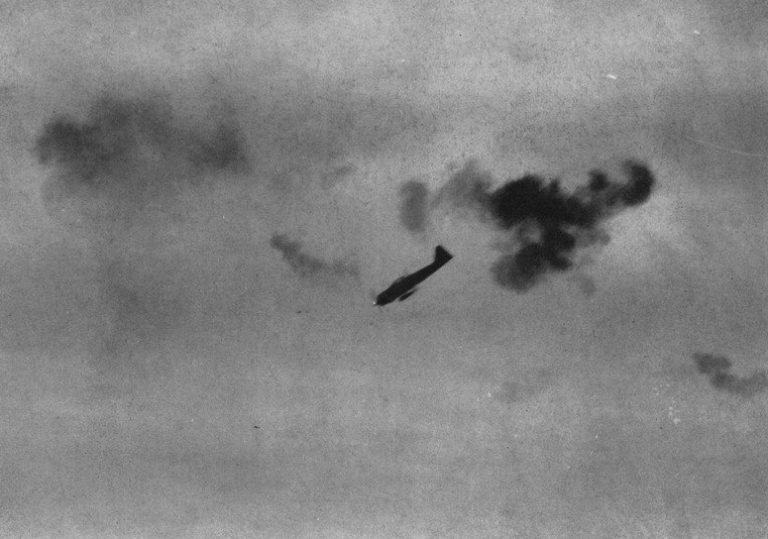
Credit: “Image courtesy of the U.S. National Archives (NARA). Public Domain.”
The kamikaze missions were not born from a sudden idea or a single emotional impulse. They emerged gradually, shaped by battlefield conditions, cultural expectations, and a generation taught to place national duty above individual desire. When military officers proposed the idea of organized special attack units, they framed it as an opportunity for ultimate sacrifice. But the emotional reality within the hearts of the pilots was far more complicated. Many were university students who had been drafted. Many enjoyed poetry, baseball, and music. Their diaries reveal ambivalence, fear, longing, and a desire for peace that contrasted sharply with the rigid public rhetoric of the era. The kamikaze phenomenon cannot be understood without acknowledging this human dimension, which is why the preserved letters displayed at the Chiran Peace Museum have become some of the most visited and carefully studied wartime artifacts in modern Japan.
The town of Chiran, located in Kagoshima Prefecture in southern Japan, was one of the primary bases from which kamikaze pilots departed on their final missions. Today it stands quietly, surrounded by soft greenery and maintained with a reverence that invites reflection rather than judgment. Here, the museum exhibits are arranged not to glorify war but to emphasize the personal lives of the young men involved. Photographs show them smiling in groups, leaning casually in uniforms that appear far too large for their age. Their letters, written in graceful Japanese script, speak of family, hope, and the emotional weight of confronting a future that had narrowed to a single irreversible path. Walking among these exhibits, a visitor experiences not the spectacle of conflict but the tenderness of memory. This approach has made Chiran one of the most important sites for understanding kamikaze history in a way that is grounded in humanity rather than sensationalism.
To reach Chiran, many travelers begin in Kagoshima, a vibrant coastal city shaped by volcanic landscapes and a rich samurai heritage. The city sits under the towering presence of Sakurajima, an active volcano whose silhouette dominates the skyline. Its constant low rumble is a reminder that the region has always existed alongside powerful natural forces. In the wartime era, Kagoshima served as a strategic location due to its proximity to Okinawa and the Philippine Sea. Today it is far from the imagery of conflict. Cafés overlook shimmering water. Ferry boats glide quietly along the bay. The journey from Kagoshima to Chiran takes visitors away from the urban center and into gently rolling countryside. This contrast between natural beauty and historical weight creates a uniquely reflective atmosphere that many travelers describe as transformative.
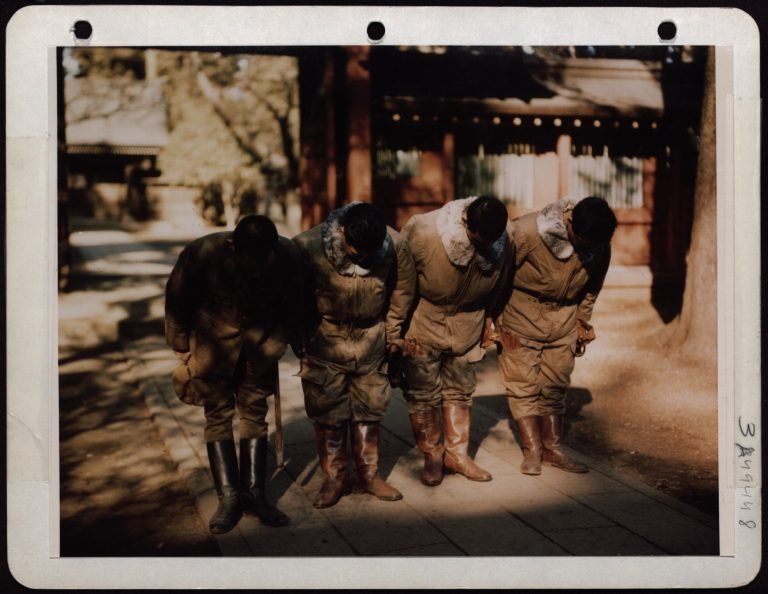
Credit: “Image courtesy of the U.S. National Archives (NARA). Public Domain.”
History, however, cannot be understood solely through preserved artifacts or museum exhibits. To grasp the emergence of the kamikaze strategy, one must look further back into Japan’s political structure, its relationship with the modern world, and the forces that shaped its military ideology long before the war began. Following the Meiji Restoration in 1868, Japan embarked on an ambitious transformation from a feudal society into a modern industrial power. This rapid modernization created both pride and tension. National identity became tied to the ideal of perseverance, discipline, and collective responsibility. When Japan entered into a series of territorial conflicts in the late nineteenth and early twentieth centuries, victories reinforced a belief in national destiny. By the 1930s, as global political tensions intensified, the military held deep influence over policy, and society became increasingly aligned with narratives of sacrifice and unity.
When the Pacific War turned against Japan, military planners looked for a strategy that could delay Allied advancement. The kamikaze missions became part of this effort. Strategically, the approach aimed to offset Japan’s diminishing resources by using determination in place of matériel. The plan relied on the belief that small, precise attacks could damage powerful enemy vessels enough to slow their momentum. But the story of these missions is not defined by tactical outcomes alone. Its significance lies in the emotional and cultural forces surrounding it. The young pilots were influenced by their upbringing, by societal expectations, and by an education system that emphasized loyalty to family and country. Understanding this environment is essential to understanding why these missions occurred.
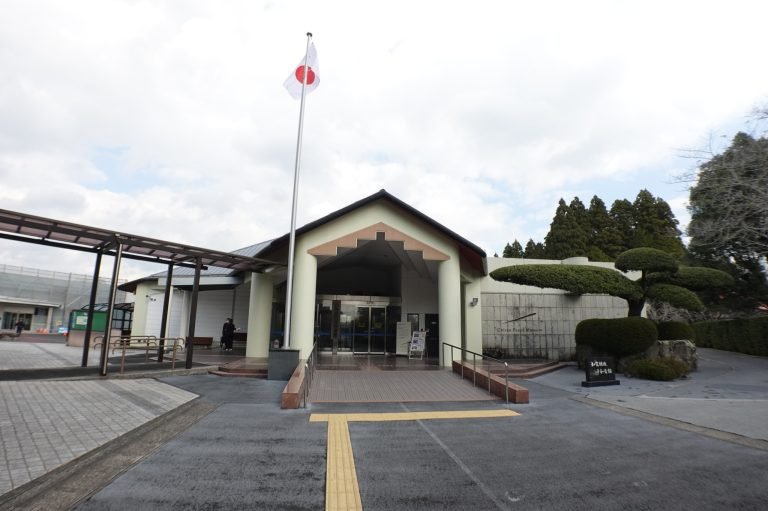
The Chiran Peace Museum plays a central role in conveying this historical complexity. The displays focus not on militaristic interpretation but on individual voices. Personal items such as diaries, school textbooks, photographs, and handkerchiefs reveal daily life rather than ideology. Visitors often pause longest at the handwritten letters. Some contain expressions of gratitude toward parents. Others speak of fear gently veiled behind polite phrasing. A few express hopes that future generations will never face similar circumstances. The museum’s curators intentionally allow these voices to guide the narrative, creating a space where reflection replaces simplistic interpretation.
Outside the museum, the original wooden barracks still stand. They are modest structures, preserved exactly as they appeared during the war. The paths between them are lined with stone lanterns donated over the decades by grieving families. The air is quiet, broken only by the soft sounds of wind passing through nearby trees. This physical setting contributes significantly to the overall experience. Walking through the barracks offers a sense of spatial memory, allowing visitors to understand the environment in which the young pilots spent their final days. It is a place where time appears suspended, inviting contemplation rather than shock.
Kagoshima itself provides additional layers of context. The city’s history includes the birthplace of several influential samurai and statesmen who shaped Japan’s modernization. Exploring Kagoshima allows visitors to see how tradition and reform coexisted long before the war, influencing the nation’s path toward modern conflict. Sites such as Sengan-en Garden and Shōko Shūseikan Museum reveal how the region became an early center of industrial innovation. When viewed alongside Chiran’s wartime exhibits, Kagoshima’s historical landscape shows the broader narrative arc of Japan’s transformation, from the Meiji era to the turbulence of the twentieth century.
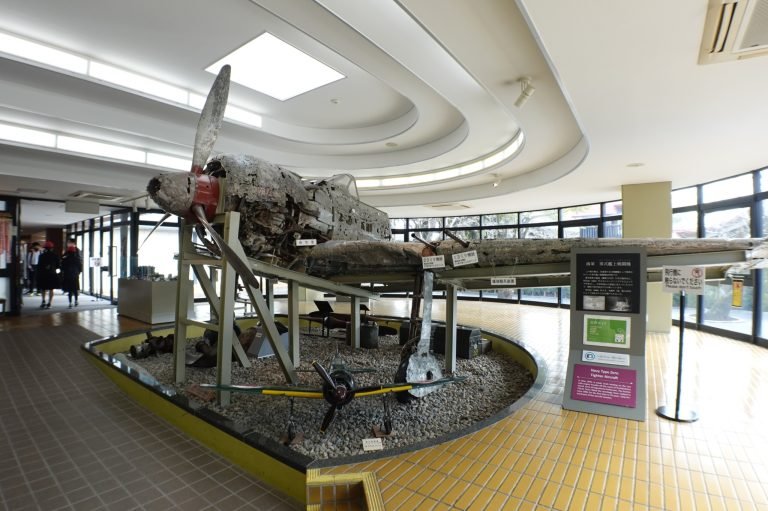
Traveling to these locations today offers not only historical understanding but a deeper connection to the emotional narrative of the era. Many visitors describe a quiet shift in perspective as they move between Kagoshima’s lively streets and the reflective stillness of Chiran. The contrast underscores how dramatically Japan has changed since the wartime period. Modern Kagoshima feels open, peaceful, and forward-looking. Chiran feels introspective, rooted in remembrance and the desire to preserve lessons for future generations.
The kamikaze story does not rest solely on military strategy or wartime urgency. It resonates because it touches on timeless questions: how societies make decisions in moments of crisis, how young people navigate expectations imposed upon them, and how nations remember periods of deep trauma. These questions remain relevant in any era. Chiran, Kagoshima, and the broader narrative of the kamikaze provide a powerful lens through which to consider them.
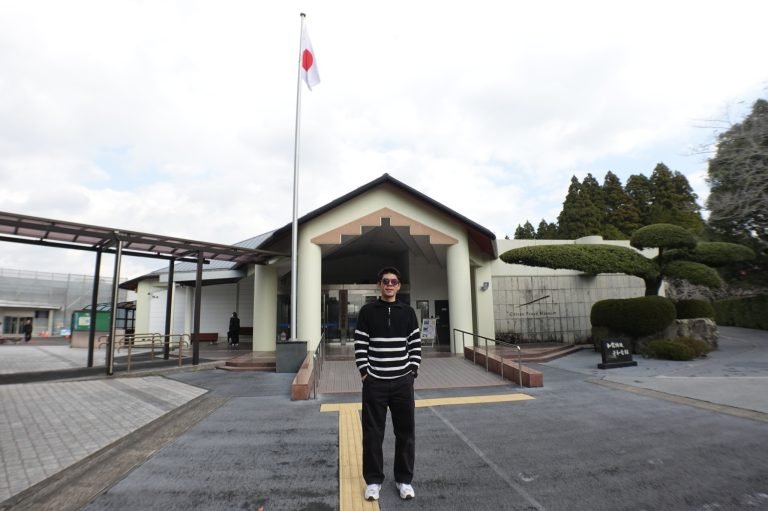
In exploring this history, one gains not only insight into Japan’s wartime experience but a heightened appreciation for peace. This is reflected in the quiet tone of the Chiran Peace Museum and its emphasis on human stories rather than conflict. The museum’s name is intentional; its goal is not to revisit destruction but to inspire understanding, empathy, and a commitment to preventing similar circumstances from occurring again.

Comment (0)