

The Silk Road has long captured the imagination of historians, travelers, and storytellers because it represents far more than a physical route connecting Asia and the Mediterranean. It is a symbol of human curiosity, the desire to explore beyond familiar boundaries, and the willingness of civilizations to trade not only goods but beliefs, languages, technologies, and artistic expressions. When we speak of the Silk Road, we are not speaking of a single road but an enormous network of land and maritime corridors that stretched thousands of kilometers, shaping the history of China, Central Asia, Persia, India, and eventually Europe. For over two millennia, these routes formed the arteries through which ideas flowed, helping to create the cultural landscape that defines Asia today.
The origins of the Silk Road began during the Han Dynasty, when emperors realized that the stability and economic power of China depended not solely on controlling its own territory but on forging relationships with distant peoples. The desire to secure alliances against northern nomadic tribes motivated the first official missions into Central Asia. These journeys revealed a world rich with horses, new crops, unfamiliar customs, and potential diplomatic partners. What began as a search for security evolved into a vast transcontinental exchange. China’s silk, prized for its smoothness and luster, became one of the most sought-after goods in western courts. In return, China received glassware, precious stones, metalwork, and knowledge that enhanced its scientific and artistic traditions. As caravans crossed deserts, mountains, and oases, they brought with them maps, celestial observations, musical instruments, medical techniques, and stories that expanded the imagination of every region they touched.
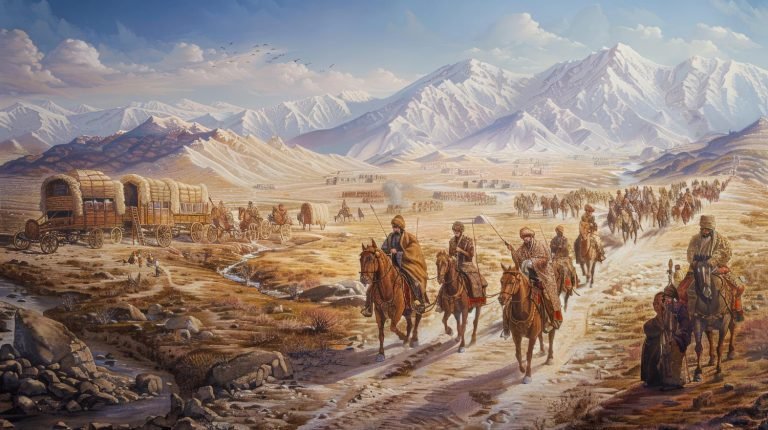
The Silk Road became a living highway of ideas. Along its deserts and fertile valleys, Buddhism traveled from India to China, carried by monks who walked through the Gansu Corridor and carved their teachings into cave temples that still survive today. Later, Islam spread eastward, shaping the identities of Central Asian cities that became renowned centers of scholarship and architecture. Traders did not travel alone; they traveled with translators, artisans, cooks, musicians, and families, forming multicultural communities within caravanserais and oasis towns. In these temporary meeting places, someone might hear stories of Roman emperors, Chinese poets, Persian astronomers, or Indian physicians, all in the course of a single night. The Silk Road created a world where people understood that civilizations grew richer through encounter rather than isolation.
For travelers today, the journey often begins in western China, where the old Han frontier once stood. The Gansu Corridor, a long fertile strip surrounded by mountains and desert, formed the main gateway from China into the wider world. Dunhuang sits at the corridor’s edge, a city that once protected the empire’s westernmost boundary. Standing near the towering sand dunes that rise behind the city, it is easy to imagine the arrival of caravans carrying silk bolts, tea, jade, and lacquerware. Beyond Dunhuang lie the Mogao Caves, one of the most remarkable legacies of the Silk Road. For centuries, monks and artists adorned these caves with murals and sculptures that reflect a synthesis of Indian, Persian, Tibetan, and Chinese artistic traditions. The caves are not merely religious monuments but visual archives of cultural fusion, each painting illustrating how the Silk Road shaped the aesthetics of entire civilizations.
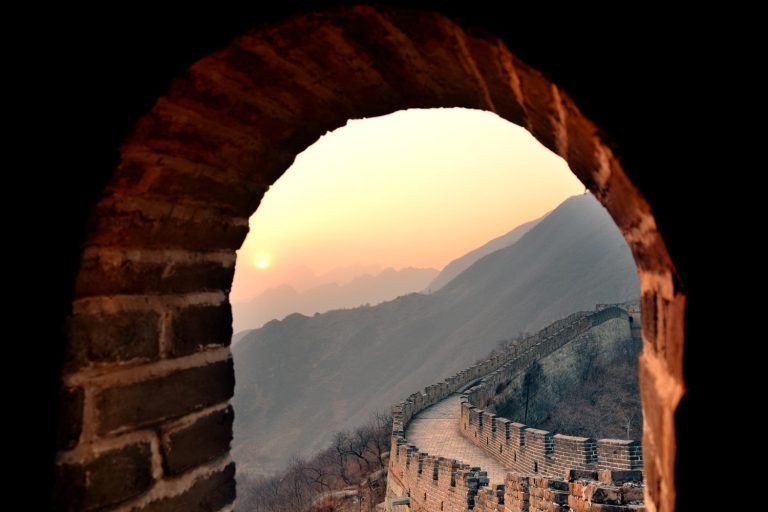
Continuing westward leads to Turpan, a desert oasis surrounded by grape valleys and ancient ruins. The city sits in one of the lowest and hottest depressions in the world, yet it thrived for millennia because of innovations brought by traders. The karez irrigation system, a network of underground channels that delivered water from distant mountains, transformed the arid landscape into fertile farmland. Exploring Turpan reveals layers of history: the ruins of Gaochang, once a cosmopolitan kingdom where Chinese officials, Sogdian merchants, and Buddhist monks coexisted; the Bezeklik Caves, where delicate frescoes testify to the cultural blend of Uyghur, Persian, and Chinese influences; and the Emin Minaret, whose slender tower rises above a city shaped by centuries of exchange.
Beyond the Chinese frontier lie the great Central Asian cities that formed the Silk Road’s beating heart. Samarkand, one of the oldest continuously inhabited cities in the world, dazzles visitors with its blue-tiled madrasas, monumental gates, and architectural squares that reflect the grandeur of Timur’s empire. Registan Square, with its symmetrical buildings covered in intricate mosaic patterns, stands as a testament to the region’s historical role as a center of science, mathematics, astronomy, and poetry. In medieval times, Samarkand attracted scholars from across Eurasia, becoming a hub where Persian literature, Islamic theology, and Chinese astronomy intersected. Walking through its bazaars today evokes a sense of timelessness, as if generations of traders still linger in the air.
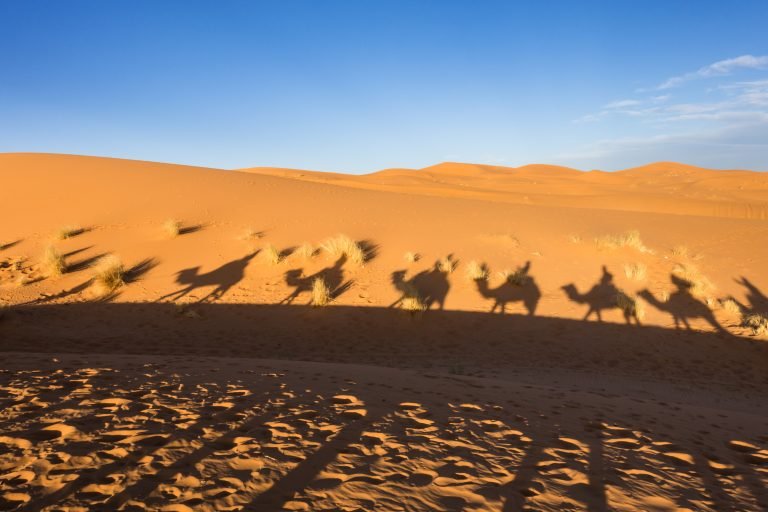
Bukhara, another jewel of Uzbekistan, offers a different atmosphere. Where Samarkand feels monumental, Bukhara feels intimate, with winding alleys, quiet courtyards, and historic mosques that reflect its role as a religious and cultural center for centuries. The old city has preserved its medieval layout, allowing travelers to experience a living museum of Silk Road urban life. At sunset, the Kalyan Minaret casts a long shadow over the adobe buildings, reminding visitors of its historical significance as a beacon for caravans traveling across the desert. Bukhara’s architecture, scholarship, and traditions demonstrate how deeply the Silk Road shaped Central Asia’s identity.
Moving further west, Khiva emerges like a mirage in the desert. Enclosed within ancient city walls, Khiva’s old town resembles a perfectly preserved medieval settlement. Narrow streets lead to tiled palaces, wooden-carved pillars, and markets that once supplied traders crossing toward Persia or the Caspian Sea. The city symbolizes the final western link of the overland Silk Road, where cultures from China, Central Asia, Persia, and the Caucasus converged.
North of Uzbekistan lies the vast Kazakh steppe, an open land where the sky feels infinite. The Silk Road passed through these grasslands for centuries, carried by nomadic tribes who understood the rhythms of the environment. While Kazakhstan’s role in the Silk Road is less architectural than its southern neighbors, its historical significance lies in mobility and connectivity. From the steppe emerged horse-riding cultures whose influence reached China, Europe, and the Middle East. The steppe also hosted trading routes connecting the north to the southern arteries of the Silk Road. Standing in Kazakhstan’s open plains, one can sense the scale of Eurasia and the unseen paths that linked its distant civilizations.
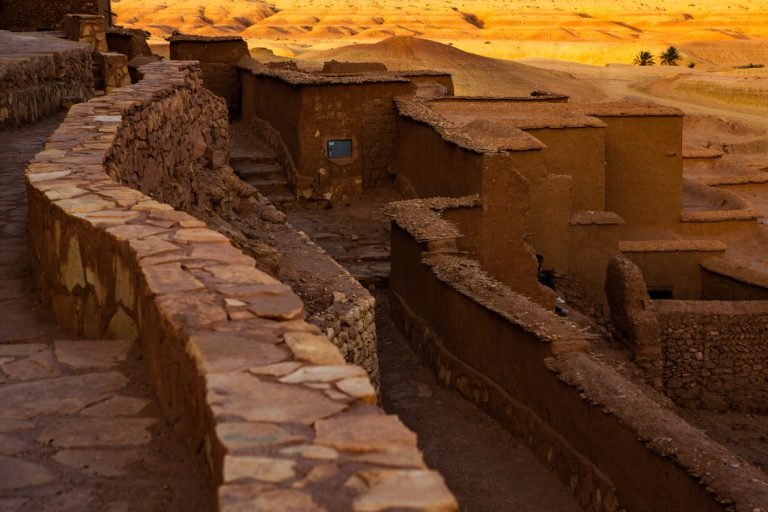
The decline of the Silk Road began gradually, influenced by shifting political powers, rising maritime trade, and the instability of overland routes. The discovery of sea routes to Asia in the fifteenth century redirected global commerce, reducing the importance of caravan trade. Yet the cultural legacy of the Silk Road did not fade. It remained imprinted in art, architecture, languages, religious practices, and the genetic footprints of populations across Eurasia. Even today, the cuisines of Central Asia bear the marks of exchange: Chinese noodles transformed into Central Asian laghman, Persian spices blended into Turkic dishes, and dairy traditions from nomadic tribes integrated into settled urban cultures.
In modern times, the Silk Road has experienced a revival in both imagination and policy. Travelers retrace ancient routes in search of history, adventure, and connection. Meanwhile, nations such as China have developed new economic initiatives that echo the ancient pathways, using the symbolism of the Silk Road to promote cultural and economic integration across Asia. For contemporary travelers, exploring the Silk Road offers a chance to step into the layered geography of human movement. From the Buddhist caves of Dunhuang to the golden domes of Samarkand, every region tells a story of exchange, adaptation, and continuity.
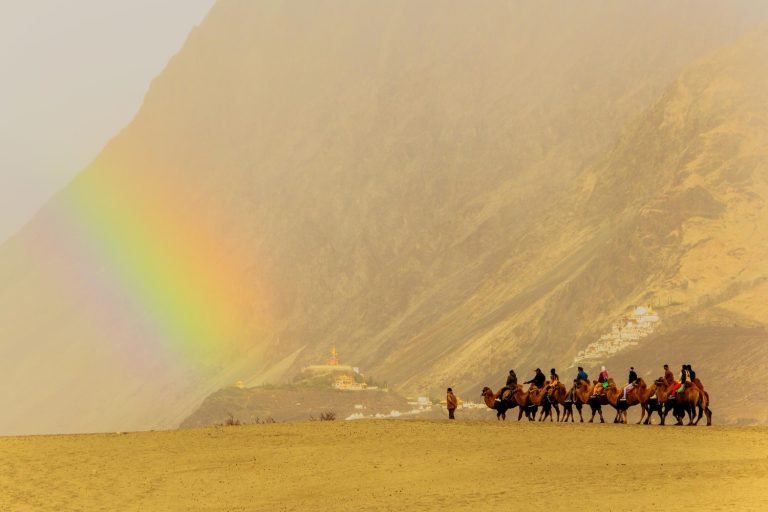
The Silk Road matters today because it demonstrates how human societies grow stronger through interaction. It reminds us that progress and creativity flourish when cultures meet. It shows that diversity is not a modern invention but an ancient condition that shaped the world long before nation-states existed. By traveling along its surviving landscapes, one witnesses the history of Asia not as isolated narratives but as intertwined threads that form a shared tapestry.
The story of the Silk Road is ultimately a story about people: the merchants guiding their camels through desert storms, the monks carrying scriptures across mountain passes, the scholars exchanging knowledge under candlelight, the artisans blending motifs from distant cultures, and the rulers who recognized that prosperity depended on connection rather than isolation. Their journeys continue to resonate in the architecture, music, languages, and traditions of China and Central Asia. To walk the Silk Road today is to feel the presence of centuries and to recognize how deeply its paths shaped the world we know.
Comment (0)