

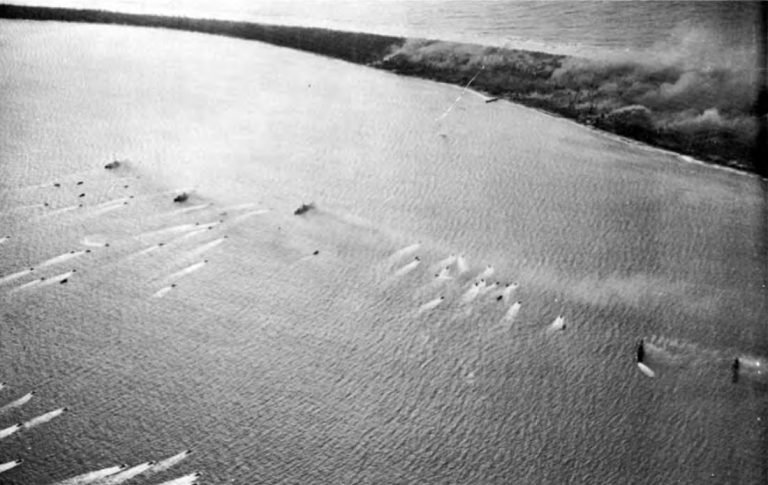
World War II in the Pacific was not a war of borders. It was a war of distance, supply lines, and control over vast stretches of ocean. Unlike Europe, where armies clashed across contiguous landmasses, the Pacific theater forced combatants to rethink what war meant. Victory was not achieved by capturing capitals alone, but by dominating sea lanes, airspace, and isolated islands scattered across thousands of miles. At the heart of this conflict lay a strategic duel between two naval visions: Imperial Japan’s quest for decisive battle and the United States’ ability to wage industrialized, sustained maritime warfare.
The Pacific became the center of global conflict because it was the connective tissue between Asia and the Americas. Whoever controlled the Pacific controlled access to resources, movement of fleets, and the ability to project power across continents. For Japan, the Pacific was both opportunity and necessity. Lacking natural resources, Japan viewed expansion southward as essential to survival. Oil from Southeast Asia, rubber, and raw materials could only be secured by breaking Western naval dominance. The Pacific was not merely a battlefield; it was Japan’s lifeline.
Credit: “Image courtesy of the U.S. National Archives (NARA). Public Domain.”
Imperial Japan entered the war with a naval doctrine shaped by tradition and experience. Influenced by earlier victories and classical naval theory, Japanese planners believed wars at sea would be decided by a single, overwhelming confrontation between fleets. Battleships symbolized national power, and decisive engagement was the goal. This doctrine valued precision, training, and courage, assuming that superior spirit could compensate for material limitations.
This vision produced remarkable tactical skill. Japanese naval aviators were among the best trained in the world at the war’s outset. Their early successes demonstrated coordination, discipline, and striking power. Yet the doctrine carried fatal assumptions. It underestimated the importance of logistics, replacement capacity, and long-term sustainability. Japan planned for victory through shock, not endurance.
The United States approached the Pacific with a fundamentally different mindset. While American naval theory recognized the importance of decisive battles, it was grounded in industrial capacity. The US did not need to win quickly. It needed to survive, adapt, and outproduce its enemy. The Pacific War became an extension of American manufacturing power. Shipyards, factories, and supply chains turned strategy into material reality.
Credit: “Image courtesy of the U.S. National Archives (NARA). Public Domain.”
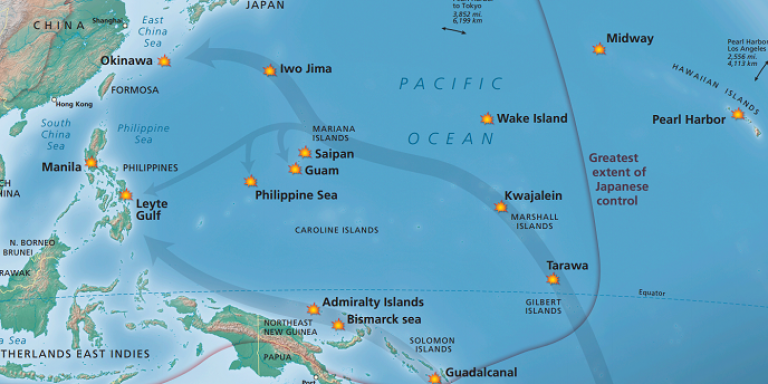
This difference became apparent as the war evolved. Japan focused on expanding its defensive perimeter, believing that forcing the US into costly assaults would weaken American resolve. The US, by contrast, accepted attrition as a strategic tool. It did not seek to retake every island. Instead, it aimed to neutralize Japanese strongholds by cutting supply lines and isolating garrisons. The ocean itself became a weapon.
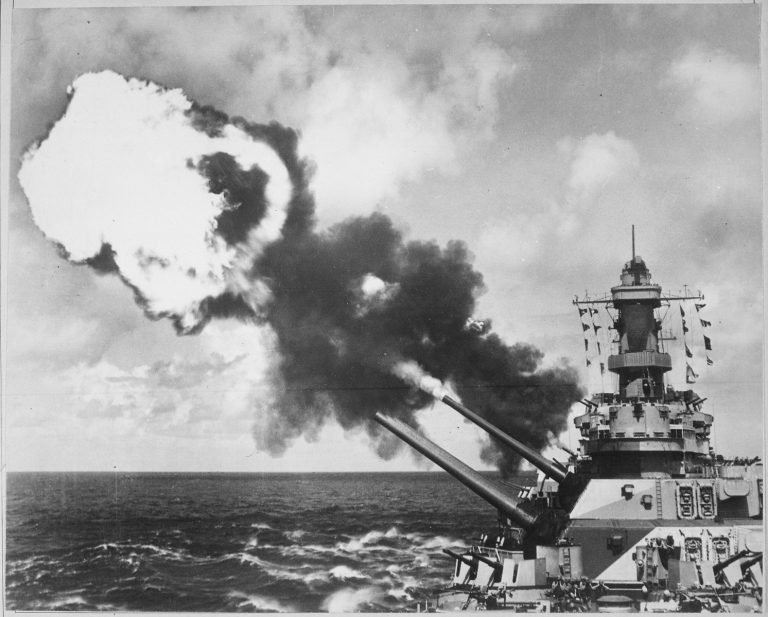
The emergence of the aircraft carrier transformed naval warfare irreversibly. Battleships, once the symbols of maritime dominance, became vulnerable to air attack. Control of the sea now depended on control of the sky above it. Aircraft carriers extended striking range beyond the horizon, making visibility irrelevant. This shift favored the United States, whose industrial base allowed rapid construction and replacement of carriers and aircraft.
The turning point of the Pacific War came not through sheer force, but through intelligence and adaptation. The Battle of Midway altered the balance irreversibly. By intercepting Japanese plans, the US Navy inflicted losses Japan could not replace. Skilled pilots and carriers were irreplaceable assets for Japan, while the US absorbed losses and expanded production. After Midway, Japan fought a defensive war with diminishing capacity to recover.
Credit: “Image courtesy of the U.S. National Archives (NARA). Public Domain.”
Island hopping emerged as the defining American strategy. Rather than frontal assaults on every occupied territory, the US selected targets based on strategic value. Capturing airfields and ports allowed gradual encroachment toward Japan while bypassed islands withered. This approach minimized casualties relative to alternatives and maximized pressure on Japan’s overstretched supply network.
Logistics became decisive. The Pacific War was a war of miles. Supplying troops across oceans required planning on an unprecedented scale. The US mastered this challenge through standardization, mass production, and coordination between military and civilian industry. Japan, constrained by limited resources and industrial bottlenecks, struggled to sustain its far-flung forces.
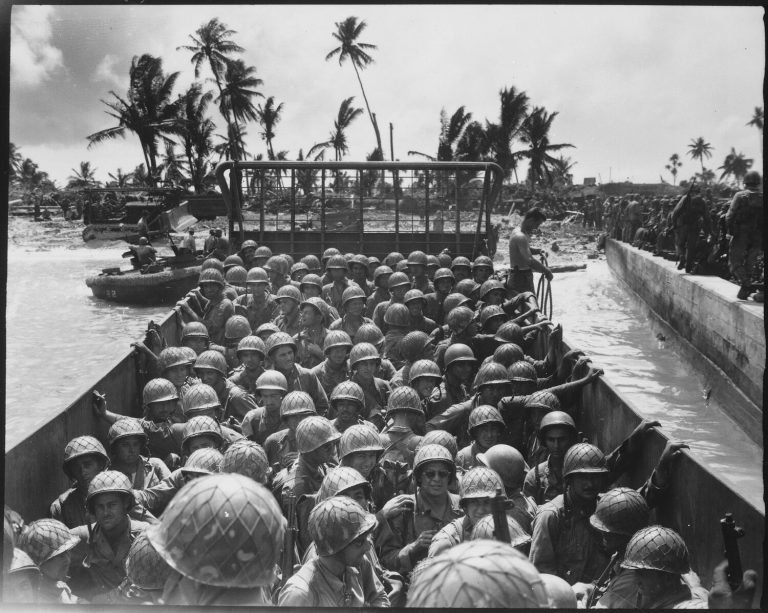
Behind strategic decisions lay immense human cost. Sailors, aviators, and island garrisons endured isolation, disease, and relentless bombardment. Naval strategy translated into individual suffering. Japanese forces stranded on bypassed islands faced starvation. American crews endured long deployments and constant threat from submarines and aircraft. The ocean was unforgiving to both sides.
Credit: “Image courtesy of the U.S. National Archives (NARA). Public Domain.”
Today, the geography of the Pacific still bears the imprint of this conflict. Islands once fought over are now quiet, yet runways, wrecks, and memorials remain. Places like Midway Atoll remind visitors that remote locations can hold global significance. Guadalcanal reflects how control of a single airstrip could alter the course of a campaign.
The Pacific War reshaped naval doctrine permanently. Modern navies emphasize carriers, submarines, and logistics over battleship duels. Control of sea lanes remains essential to global stability. The strategic lessons learned between the US and Japan continue to influence military planning across the world.
The Battle for the Pacific was not won by bravery alone, nor by ideology. It was decided by strategy aligned with reality. Japan fought for decisive moments. The United States fought for endurance. In a war defined by distance and scale, endurance prevailed.

Comment (0)