

Across much of Asia, social behavior is guided less by internal guilt and more by external shame. This difference often confuses outsiders. Actions that might be explained in the West through personal conscience are in Asia frequently understood through reputation, social harmony, and the gaze of others. This is not a sign of emotional immaturity or moral deficiency. It is the result of historical conditions that shaped how societies survived.
Shame and guilt are not interchangeable emotions. Guilt is internal. It arises when an individual violates a personal moral code. Shame is relational. It arises when behavior disrupts social harmony or damages collective standing. One concerns the self. The other concerns belonging.
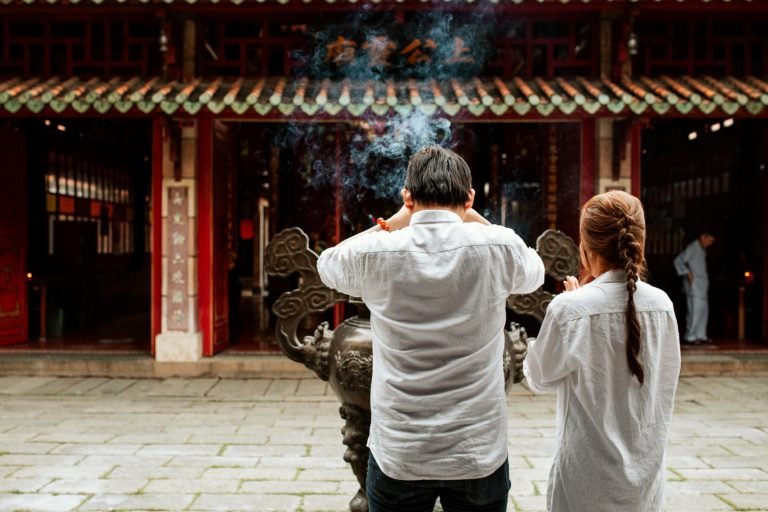
Confucian ritual emphasizing social order
Asian societies historically prioritized survival in dense, interdependent environments. Villages, clans, and extended families formed the core of social organization. Individual behavior carried consequences not only for the person, but for the group. In such conditions, moral systems evolved to regulate visibility rather than intention.
Collective identity mattered more than individual expression. Maintaining harmony was essential for survival. Shame became a powerful tool because it aligned behavior with group expectations without requiring centralized enforcement.
Confucian philosophy formalized this logic. Moral behavior was not judged solely by inner intention, but by outward conduct. Virtue was visible. Respect was performative. Order depended on each person knowing their place.
In East Asia, these values shaped social interaction for centuries. Honor and face were not abstract concepts. They were practical mechanisms that maintained stability across large populations.
Shame functioned as social memory. Actions were remembered collectively. Reputation endured beyond the moment. This continuity reinforced conformity and discouraged behavior that threatened cohesion.
Colonialism and modern warfare intensified the role of shame. Asian societies experienced repeated humiliation through conquest, occupation, and unequal treaties. Survival required restraint. Speaking openly could invite punishment. Silence became protective.

Asian family gathering reflecting collective identity
In Japan, shame was reinforced through concepts of honor and responsibility. Failure reflected not only on the individual, but on family and nation. After World War II, silence about certain topics was less about denial than about preserving fragile social stability.
In China, collective shame from historical humiliation shaped modern nationalism. Memory became a shared emotional resource. Personal guilt mattered less than collective dignity.
In Korea, colonial trauma and war reinforced the importance of saving face. Public failure carried heavy social consequences. Emotional expression was disciplined by necessity.

Crowded streets of Tokyo illustrating social awareness
Guilt, by contrast, assumes a moral system where individuals stand apart from the group. It assumes legal equality, personal autonomy, and stable institutions. These conditions emerged later in Asia and unevenly.
Shame remained effective because it operated socially. It did not require courts, confessions, or internal reflection. It worked through relationships, observation, and memory.
Modernization did not erase this emotional structure. Cities grew, economies expanded, and education systems changed, but emotional habits persisted. Shame adapted rather than disappeared.
In Seoul, Tokyo, and Shanghai, modern life coexists with deep sensitivity to social perception. Online behavior amplifies this dynamic. Digital shame spreads faster than guilt ever could.
Outsiders often misinterpret this as repression. In reality, it is a different moral grammar. Shame regulates behavior through belonging rather than isolation.

Urban life in Asia shaped by social harmony
Misunderstanding this difference leads to cultural friction. Western frameworks emphasize personal responsibility and confession. Asian frameworks emphasize restoration of harmony and avoidance of disgrace.
Neither system is inherently superior. Each reflects the conditions under which it evolved. Asia’s history demanded emotional tools that prioritized survival over self-expression.
Shame carries more weight than guilt in Asia because it has carried societies through centuries of density, hierarchy, trauma, and adaptation. It is not a flaw. It is a legacy.
Understanding this helps explain behavior, communication styles, and even political dynamics across the region. Shame is not weakness. It is memory acting socially.
Asia does not lack conscience. It locates it differently.



Comment (0)